Technology Overview
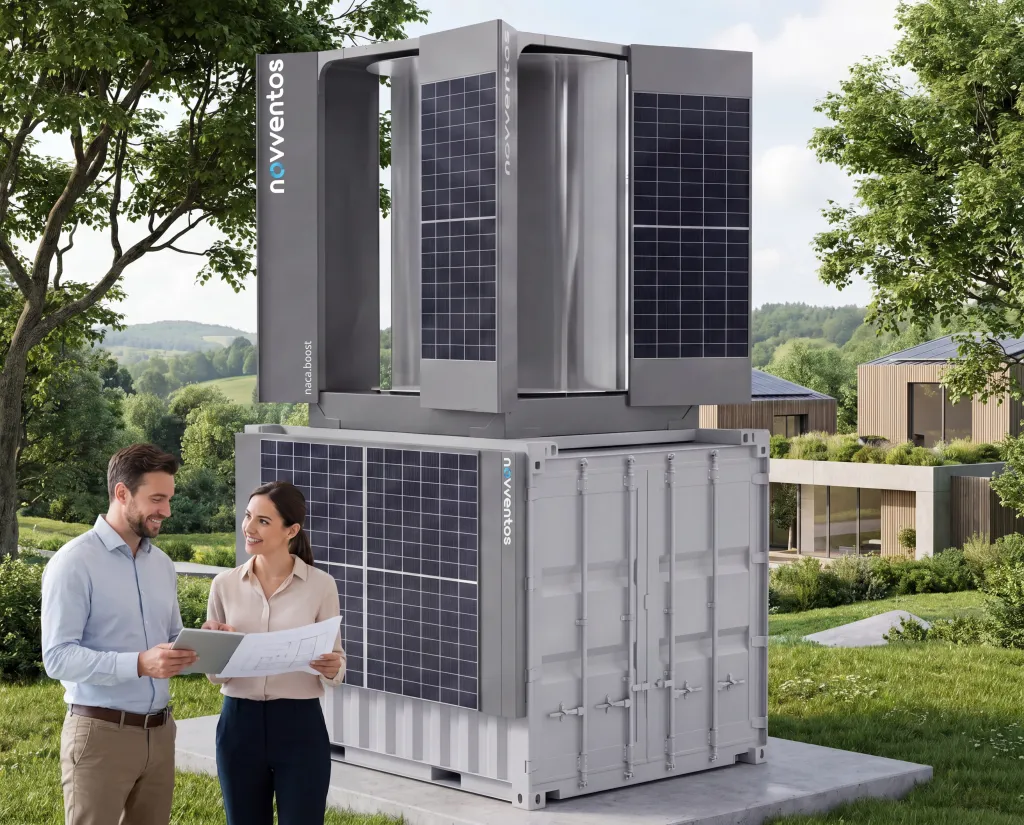
novventos develops an integrated platform for autonomous renewable energy generation at off-grid and decentralised sites. Three purpose-built products - naca.boost (wind), sky.boost (solar), and master.boost (energy management) - function as a single coordinated system, each solving a specific engineering problem and each designed to connect natively with the others.
The platform targets three compounding limitations of conventional small-scale renewables: the low power coefficient of near-ground wind turbines, the slow and infrastructure-heavy deployment of solar generation, and the absence of intelligent multi-source energy control in most off-the-shelf systems.
naca.boost - Vertical Axis Wind Turbine
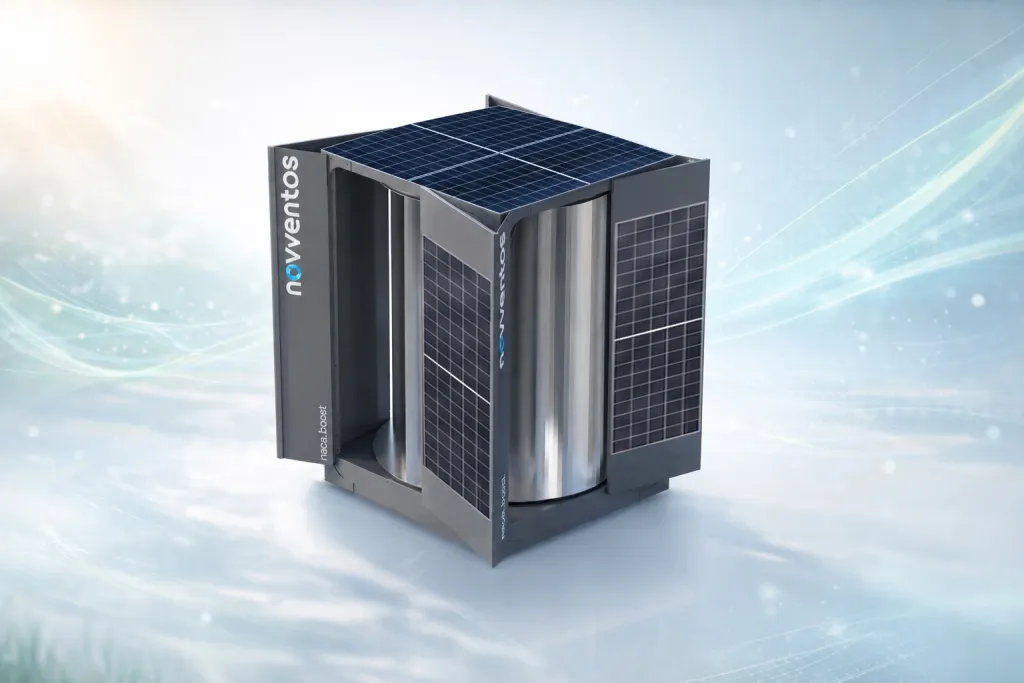
naca.boost is designed to harvest wind energy efficiently at installation heights of 3 - 8 metres - the near-ground environment where most off-grid demand is located and where conventional small turbines perform worst.
Airflow at these heights is turbulent, multi-directional, and significantly slower than at altitude: conditions that defeat horizontal-axis designs and severely constrain drag-based vertical-axis rotors.
The near-ground problem
Standard vertical-axis drag rotors - the Savonius type - are structurally capped at a power coefficient (Cp) of approximately 0.20. The fundamental reason is the returning blade: one half of the rotor always moves against the incoming wind, generating opposing drag that limits net torque and caps energy extraction at roughly one-fifth of the available resource, regardless of wind speed. Large horizontal-axis turbines approach the theoretical Betz limit of 59.3% under ideal conditions, but they require laminar, directionally consistent airflow and installation heights incompatible with rooftop or container deployment. No established small-turbine design performs well in the near-ground environment. naca.boost was developed to close this gap.
Hybrid lift-and-drag rotor
The naca.boost rotor uses airfoil-shaped blades in a proprietary novventos geometry that generates lift forces in addition to drag. This distinction is fundamental. Lift acts perpendicular to the direction of relative airflow across the blade surface - it is not directly opposed by the returning blade's motion. Lift forces are substantially stronger than drag forces at comparable wind speeds, and they enable tip-speed ratios that exceed the incoming wind velocity. This means the blade surface can move faster than the wind driving it - a physical condition that drag-only designs cannot achieve, because their net torque is always the difference between the advancing and returning blade forces.
The consequence is a power coefficient substantially above 0.20. The rotor generates useful torque across a wider range of wind speeds and directions than either a pure-lift or pure-drag design would achieve independently, and it does so continuously - the aerodynamic advantage is present at every wind speed, not only at peak conditions.
Intelligent aerodynamic housing
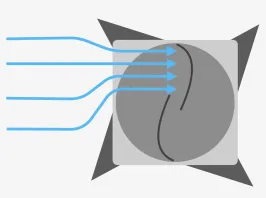
The asymmetric housing is the second principal innovation. It performs three functions simultaneously. On the returning side, it encloses the rotor and diverts incoming airflow away from the retreating blade, eliminating its braking effect entirely - the blade moves through a protected slipstream rather than fighting the wind.
On the advancing side, the housing geometry converges the incoming airstream before it reaches the rotor swept area, increasing its local velocity. Because wind power scales as the cube of velocity, even a moderate increase at the rotor face produces a disproportionately large gain in extractable energy. The third function is directional: the vertical-axis configuration accepts wind from any horizontal direction without mechanical yaw adjustment. Rather than being damaged by turbulent or multi-directional near-ground airflow, the rotor is driven by it - turbulence becomes an operating advantage rather than a performance loss.
Measured performance
The combined effect of the lift-and-drag rotor and the intelligent housing delivers at least a 75% improvement in energy output over the conventional near-ground VAWT benchmark at the same installation height and from the same wind resource. naca.boost also achieves a lower cut-in wind speed than drag-only designs, extending productive generating hours across lighter wind conditions.
The improvement compounds through the annual operating profile: more hours of generation, at higher output per hour, without any of the civil engineering requirements that make altitude installations impractical at decentralised sites.
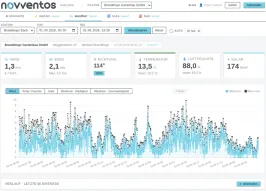
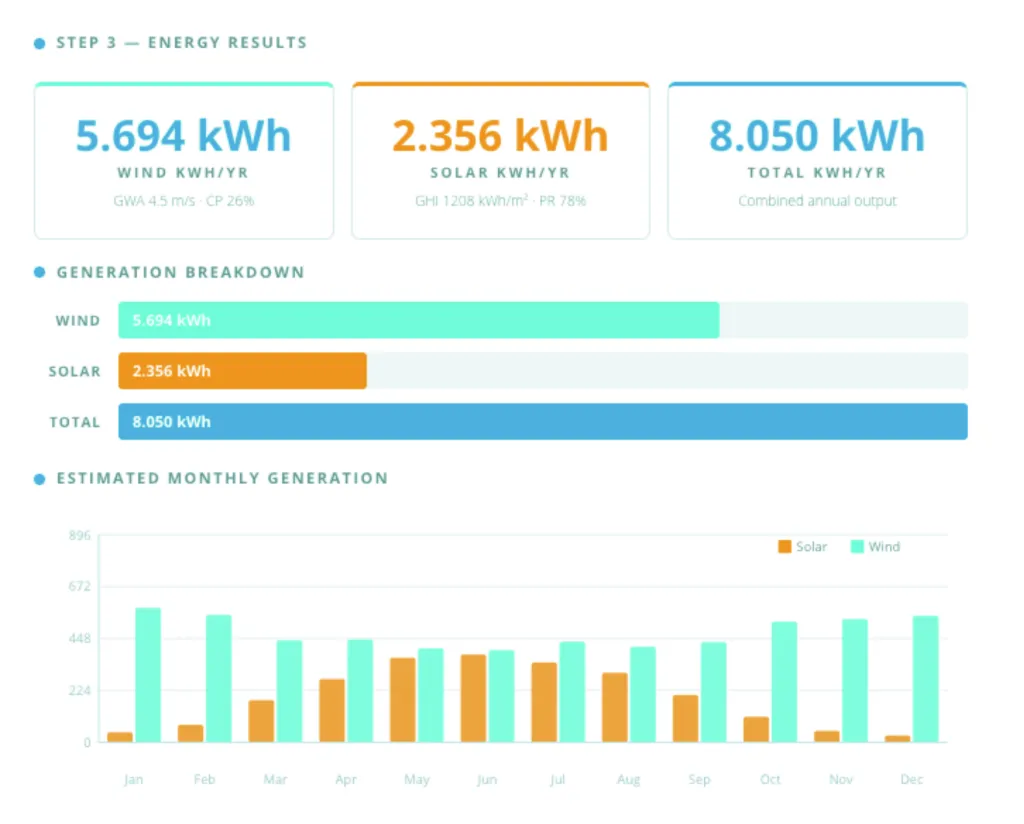
Hybrid Energy: Wind & Solar in perfect union
Reliability beats peak performance
novventos treats supply reliability as the primary design objective, not peak generation. A hybrid system delivering 95% uptime with modest storage is commercially more viable than a single-source system with peak output on good days and nothing on bad ones.
The solar-only limitation
Solar output is constrained by daylight hours and atmospheric conditions. Panels produce nothing at night and far less on overcast days. At mid-latitudes in winter, daily solar irradiation falls to approximately one-fifth of peak summer output. Any solar-only system must carry battery capacity proportional to worst-case production gaps.
The wind-only limitation
Wind resources are complementary in seasonality but equally variable on hourly and daily timescales. No location offers consistently predictable wind across all operating hours. Relying on wind alone requires battery storage large enough to bridge multi-day low-wind events - storage that dominates system economics.
Solving the Variability Problem
When wind and solar are managed together, each source compensates for the other's gaps. The combined output curve is significantly smoother than either source alone. The result is a substantial reduction in battery capacity required - with direct impact on system cost, weight, and logistics. This is where our smart master.boost system manages all energy flows between naca.boost, sky.boost, battery storage, and connected loads. It balances both sources simultaneously in real time, prioritizing the most available source and managing battery charge cycles. Full remote visibility is available via the novventos data.mine.
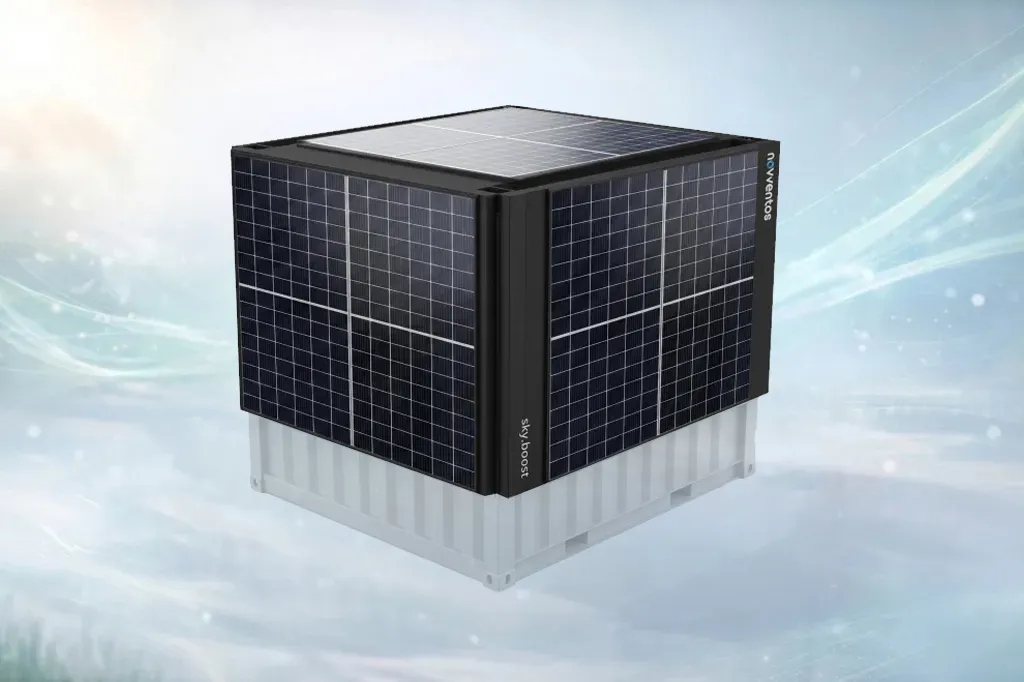
sky.boost - Modular Solar Array
sky.boost is a photovoltaic array engineered for rapid deployment on standard ISO shipping containers and flat roofs. The technical innovation is not the solar cell but the mounting system: a purpose-designed bracket frame that installs directly onto 10- 16- or 20-foot ISO containers without structural preparation, penetration, or specialist equipment - arriving operational within hours rather than days. Modules are stackable, crane- and forklift-compatible, and scale incrementally as capacity grows, without reconfiguring existing units.
sky.boost output is naturally complementary to naca.boost: solar peaks during high-irradiance periods while wind generation is strongest at night, in overcast conditions, and in winter. Managed together by master.boost, the combined output profile is substantially smoother than either source alone, directly reducing the battery storage capacity required to maintain continuous supply.
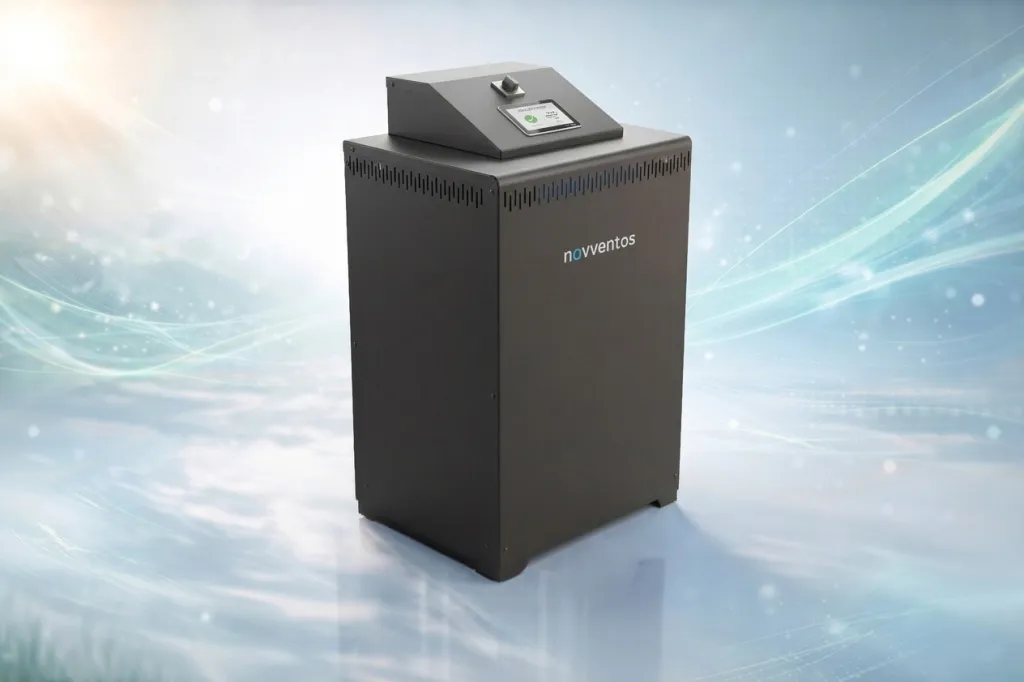
master.boost - Control and Energy Hub
master.boost is the central energy management unit of every novventos installation. It receives simultaneous inputs from wind, solar, grid, hydropower, and diesel or petrol generators; balances them in real time; and routes power to connected loads or battery storage without operator intervention. The cabinet arrives pre-wired and pre-labelled - installation requires connection to sources and loads only.
Do you have any questions?
Contact us – together, we'll find the optimal solution for your requirements!